- Details
…to give them YOUR creative work for free!
New Exposure Photography Competition
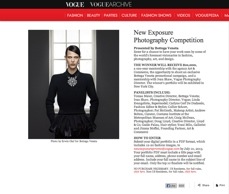 "Enter for a chance to have your work seen by some of the world's foremost visionaries in fashion, photography, art, and design"
http://promotions.vogue.com/promo_newexposure2013.php
What's the price?
7. (a) "All entry materials become the property of the Sponsor … entry into this Promotion constitutes entrant's irrevocable and perpetual permission and consent, without further compensation, with or without attribution, to … sell, perform, adapt, enhance, or display such Submission, and the entrant's name and/or likeness, for any purpose, including but not limited to editorial, advertising, trade, commercial, … in any and all media now in existence or hereinafter created, throughout the world, for the duration or the copyright in the Submission." - Quoted from the Official Contest Rules
One winner, countless entries, equals a lot of young creative talent giving away pertetual rights to deep pockets. What kind of example does this set?
- Details
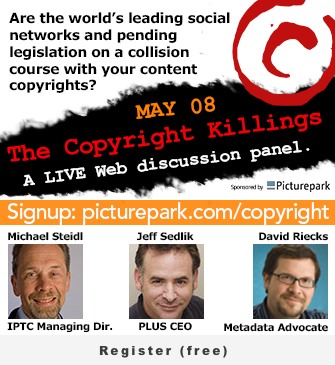
Did you miss the "Copyright Killings" webinar?
Watch it now!
- Learn "best practices" to keep your work from becoming orphaned
- How pending legislating may put your creative rights at risk
- What is "metadata" and why it is important
- Discover resources to followup with your new knowledge
Click on the image to the right for all the above, and more!
- Details
 An "orphan work" is an image, illustration, text, etc., whose owner cannot be identified or found. The recent passage of UK's ERRB paves the way for real and massive rights abuse unless new and effective search schema are developed, tested, and implemented very quickly. Why?
"Why? Because social media, and everyone else for that matter routinely strip our names and contact details from our digital files. … So now commercial organisations will be allowed to make money from our “orphans”, but not us, the creators." David Bailey, iconic British photographer, in a letter to The Chancellor of the Exchequer, George Osborne MP, via theBPPA.
No workable system yet exists to identify who owns an image on the basis of image pixels alone. Yet there are tens of millions of "orphan works" residing on the internet already, having been created by most every social media host to date.
- Details
 Recent legislation passed by the UK Parliament and endorsed by the Royals has caused a firestorm among photographers and illustrators in the UK and abroad.
Time has come to remove your work from Facebook, Twitter, Instagram, etc
"UK.Gov passes Instagram Act: All your pics belong to everyone now"
"Amateur and professional illustrators and photographers alike will find themselves ensnared by the changes, the result of lobbying by Silicon Valley and radical bureaucrats and academics. The changes are enacted in the sprawling Enterprise and Regulatory Reform Act which received Royal Assent last week, and it marks a huge shift in power away from citizens and towards large US corporations."
Andrew Orlowski, theregister.co.uk
Until now, it was illegal to exploit a copyrigted work without the consent of the owner.
"The EAA Act changes all that. Under its provisions it will be legal to exploit a copyright work - photograph, film, text, song, whatever - without the knowledge or permission of, or payment to, its owner."
Paul Ellis, Stop43.org.uk
- Details
 Call to Action!
On Tuesday 16th April the Enterprise and Regulatory Reform Bill enters its final Parliamentary phase before becoming law. This is your last chance to remove from it the damaging Orphan Works and Extended Collective Licensing Clause 79. Please contact your MP and other Parliamentarians, making the following recommendations:
- Remove the Orphan Works and Extended Collective Licensing Clause 79 from the ERR Bill
- Implement the EU Orphan Works Directive at the last possible moment, because it directs us to breach our obligations to foreign rights owners under the Berne Convention
- Revisit IP in an Intellectual Property Bill once the Copyright Hub is operational and the government has a metadata policy, which at the moment it does not
- Return responsibility for copyright to the Department for Culture, Media and Sport. Patentsare limited formal economic rights granted by Government upon application, and rightly handled by the Patents Office (which is an Agency of the Department for Business, Innovation and Skills, and of which ‘Intellectual Property Office’ is an operating name). Copyright is an informal automatic combined economic, cultural and human right. It is far more appropriate for the Department for Culture to be responsible for this more subtle right than the Department for Business.
Embedded Metadata Manfesto
 We Support the
Embedded Metadata Manifesto
Want To Become A Supporter?
Individuals who wish to support our cause may use the logo below on their website. Please link to Artists' Bill of Rights. Right click logo & choose 'save as'.

Organisations wishing to be a supporter; please contact us.